(Peer-Reviewed) NIR-triggered on-site NO/ROS/RNS nanoreactor: Cascade-amplified photodynamic/photothermal therapy with local and systemic immune responses activation
Ziqing Xu 徐子晴 ¹, Yakun Kang 康亚坤 ², Jie Zhang 张洁 ¹, Jiajia Tang 汤佳佳 ¹, Hanyao Sun 孙汉垚 ¹, Yang Li 李阳 ¹, Doudou He 何豆豆 ¹, Xuan Sha 沙萱 ¹, Yuxia Tang 唐玉霞 ¹, Ziyi Fu 付子毅 ³, Feiyun Wu 吴飞云 ¹, Shouju Wang 王守巨 ¹
¹ Laboratory of Molecular Imaging, Department of Radiology, The First Affiliated Hospital of Nanjing Medical University, Nanjing 210029, China
中国 南京 南京医科大学第一附属医院 放射科 分子影像实验室
² Department of Breast Surgery, The First Affiliated Hospital of Nanjing Medical University, Nanjing 210029, China
中国 南京 南京医科大学第一附属医院 乳腺外科
³ Department of Women & Children Research Center, The First Affiliated Hospital, Nanjing Medical University, Nanjing 210029, China
中国 南京 南京医科大学第一附属医院 妇幼中心实验室
Opto-Electronic Advances, 2024-06-05
Abstract
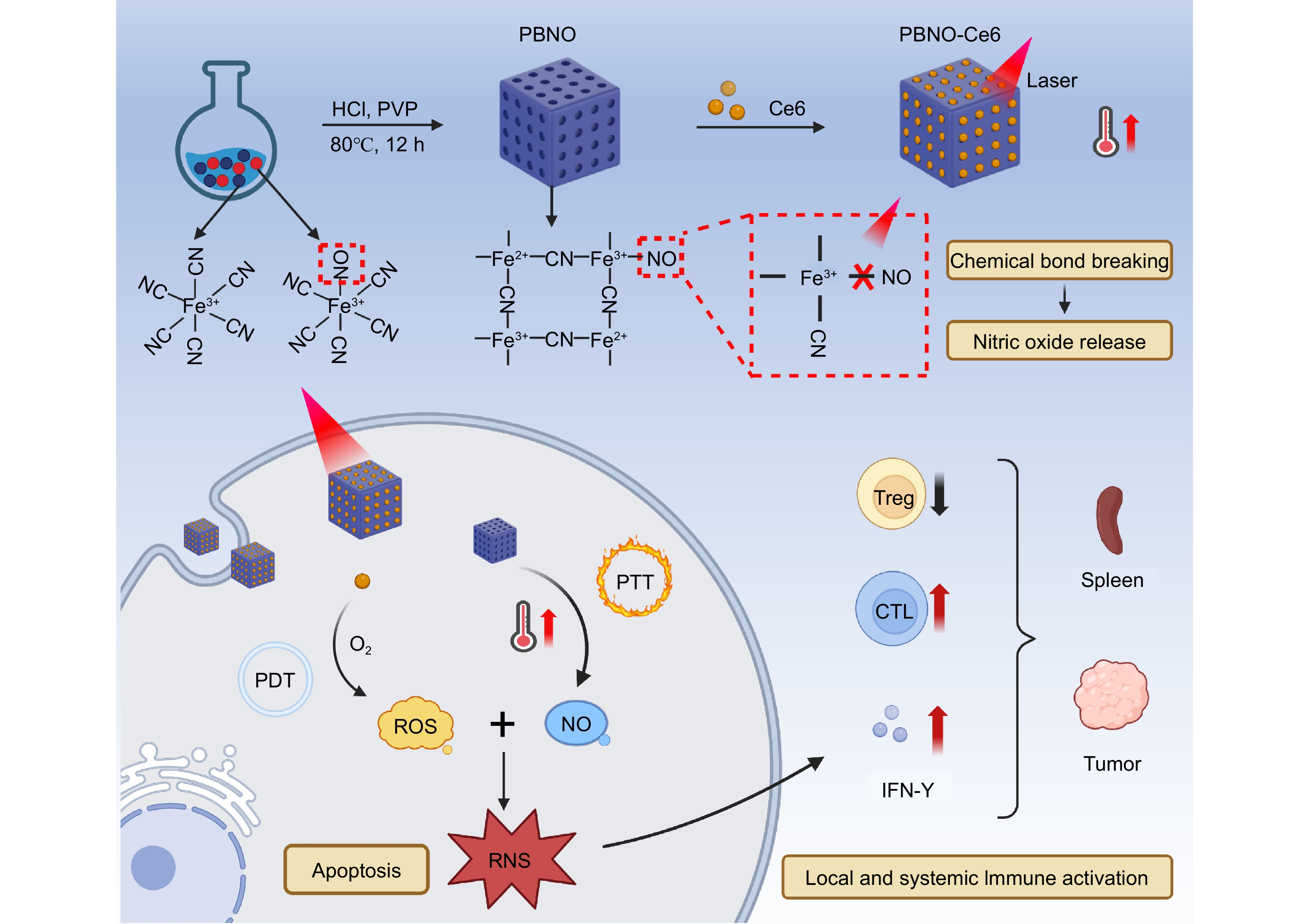
Photothermal and photodynamic therapies (PTT/PDT) hold promise for localized tumor treatment, yet their full potential is hampered by limitations such as the hypoxic tumor microenvironment and inadequate systemic immune activation. Addressing these challenges, we present a novel near-infrared (NIR)-triggered RNS nanoreactor (PBNO-Ce6) to amplify the photodynamic and photothermal therapy efficacy against triple-negative breast cancer (TNBC).
The designed PBNO-Ce6 combines sodium nitroprusside-doped Prussian Blue nanoparticles with Chlorin e6 to enable on-site RNS production through NIR-induced concurrent NO release and ROS generation. This not only enhances tumor cell eradication but also potentiates local and systemic antitumor immune responses, protecting mice from tumor rechallenge. Our in vivo evaluations revealed that treatment with PBNO-Ce6 leads to a remarkable 2.7-fold increase in cytotoxic T lymphocytes and a 62% decrease in regulatory T cells in comparison to the control PB-Ce6 (Prussian Blue nanoparticles loaded with Chlorin e6), marking a substantial improvement over traditional PTT/PDT.
As such, the PBNO-Ce6 nanoreactor represents a transformative approach for improving outcomes in TNBC and potentially other malignancies affected by similar barriers.
A 36 × 240 Gbps hybrid mode/wavelength division multiplexing transmitter using lithium niobate on insulator
Mingyu Zhu, Weihan Wang, Ruitao Ma, Aoyun Gao, Chun Gao, Zexu Wang, Fei Huang, Zhenyuan Bao, Dajian Liu, Jiaxuan Gan, Zejie Yu, Huan Li, Weike Zhao, Daoxin Dai
Opto-Electronic Advances
2026-08-25
Light-perception-based interactive control of an underwater digital twin hand
Jinlong Lu, Chao Zhang, Hengchang Nong, Dongying Wang, Hongyu Zhou, Junjie Weng, Yuehua Deng, Yang Yu, Qiang Bian, Jianfa Zhang, Chaofan Zhang, Zhenrong Zhang, Junbo Yang
Opto-Electronic Advances
2026-07-10
Unlocking home-based nocturnal health management: A fiber-optic approach for early detection of cardiorespiratory rhythm disorders
Hanyu Jin, Hao Li, Zhuolin Chen, Liangye Li, Zurui Wang, Kai Zhou, Weijian Hang, Zhipeng Chen, Junfeng Chen, Kai Shen, Jianfeng Wen, Chen Chen, Cunzheng Fan, Zhijun Yan, Feng Wang, Qizhen Sun
Opto-Electronic Advances
2026-07-10
A flexible wireless system for prospective photodynamic therapy applications
Rolan Mansour, Bhavani Yalagala, Vikas Vikas, Nikolas Bruce, Fawziye Tarhini, Georgios N. Arvanitakis, Mohammed Mughal, Jamie Blanche, Ahmad Taha, Jonathan Copper, Muhammad Imran, Karin Williams, Karin Oien, Mahmoud Wagih, Hadi Heidari, Robert Hadfield, David Flynn
Opto-Electronic Advances
2026-07-10
Parallel bright-field and multi-order edge imaging via wide field-of-view trichannel metalens
Xiaotong Li, Yeseul Kim, Youngsun Jeon, Junhwa Seong, Jaekyung Kim, Peng Tang, Shiqi Hu, Harit Keawmuang, Beomha Yang, Dongmin Jeon, Le Dai, Weiyan Li, Xiaodong Cai, Jinhui Shi, Yong-Sang Ryu, Trevon Badloe, Junsuk Rho
Opto-Electronic Advances
2026-07-10