(Peer-Reviewed) Soliton microcomb generation by cavity polygon modes
Botao Fu 付博涛 ¹ ⁴, Renhong Gao 高仁宏 ¹ ⁶, Ni Yao 姚妮 ², Haisu Zhang 张海粟 ³, Chuntao Li 黎春桃 ³, Jintian Lin 林锦添 ¹ ⁵, Min Wang 汪旻 ³, Lingling Qiao 乔玲玲 ¹, Ya Cheng 程亚 ¹ ³ ⁴ ⁶ ⁷
¹ State Key Laboratory of High Field Laser Physics and CAS Center for Excellence in Ultra-Intense Laser Science, Shanghai Institute of Optics and Fine Mechanics (SIOM), Chinese Academy of Sciences (CAS), Shanghai 201800, China
中国 上海 中国科学院上海光学精密机械研究所 强场激光物理国家重点实验室 超强激光科学卓越创新中心
² Research Center for Frontier Fundamental Studies, Zhejiang Lab, Hangzhou 311100, China
中国 杭州 之江实验室 前沿基础研究中心
³ Engineering Research Center for Nanophotonics & Advanced Instrument, Ministry of Education, School of Physics and Electronic Science, East China Normal University, Shanghai 200241, China
中国 上海 华东师范大学物理与电子科学学院 纳光电集成与先进装备教育部工程研究中心
⁴ School of Physical Science and Technology, ShanghaiTech University, Shanghai 200031, China
中国 上海 上海科技大学 物质科学与技术学院
⁵ Center of Materials Science and Optoelectronics Engineering, University of Chinese Academy of Sciences, Beijing 100049, China
中国 北京 中国科学院大学 材料科学与光电工程中心
⁶ Shanghai Research Center for Quantum Sciences, Shanghai 201315, China
中国 上海 上海量子科学研究中心
⁷ Hefei National Laboratory, Hefei 230088, China
中国 合肥 合肥国家实验室
Opto-Electronic Advances, 2024-07-25
Abstract
Soliton microcombs, which require the hosting cavity to operate in an anomalous dispersion regime, are essential to integrate photonic systems. In the past, soliton microcombs were generated on cavity whispering gallery modes (WGMs), and the anomalous dispersion requirement of the cavity made by normal dispersion material was achieved through structural dispersion engineering. This inevitably degrades the cavity optical quality factor (Q) and increases pump threshold power for soliton comb generation.
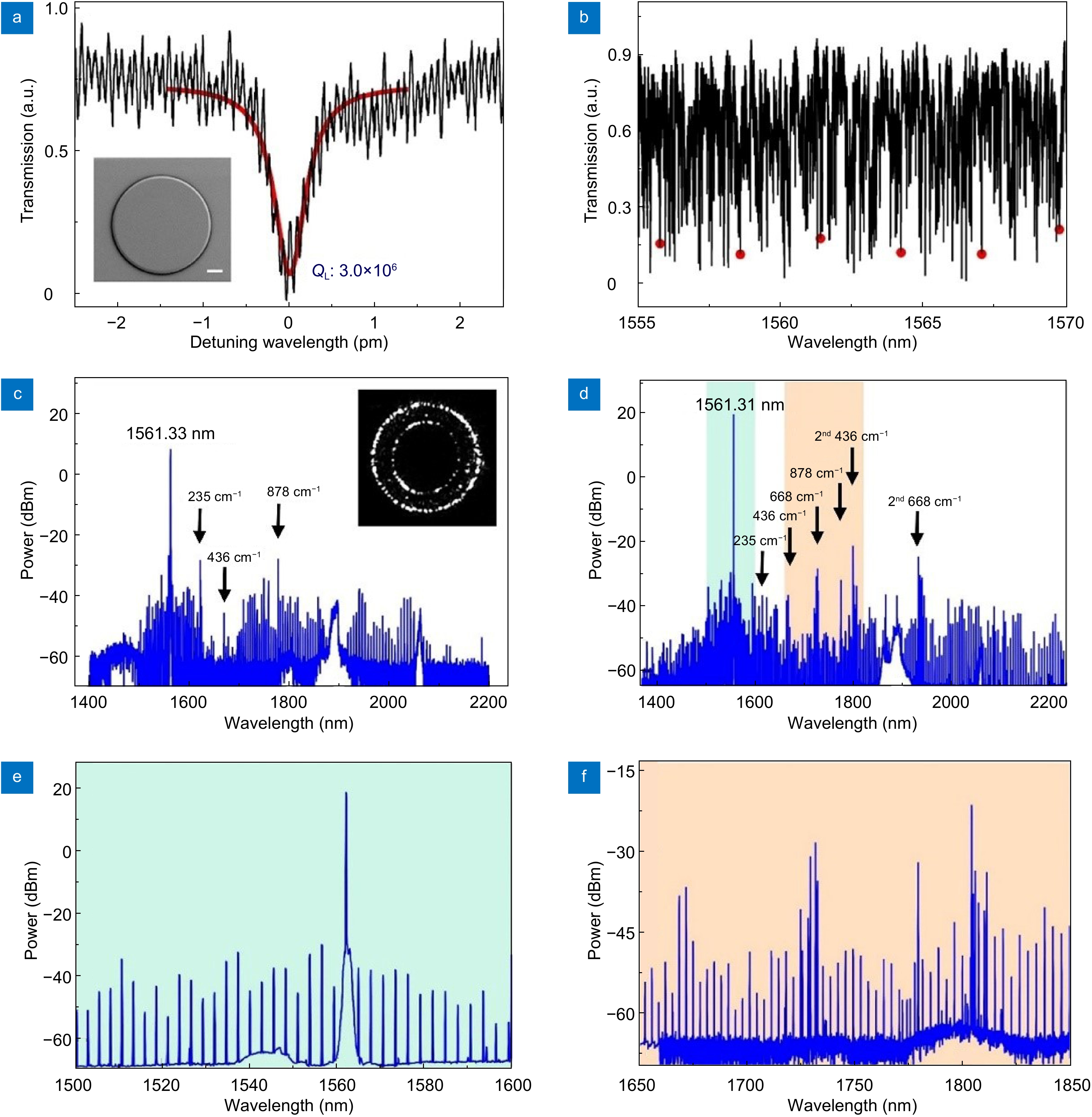
To overcome the challenges, here, we report a soliton microcomb excited by cavity polygon modes. These modes display anomalous dispersion at near-infrared while optical Q factors exceeding 4×10⁶ are maintained. Consequently, a soliton comb spanning from 1450 nm to 1620 nm with a record low pump power of 11 mW is demonstrated, a three-fold improvement compared to the state of the art on the same material platform.
Heterogeneously integrated micro-ring with SnS₂ for dual-functional optical modulation and photodetection
Jinyi Du, Lidan Lu, Xu Zhang, Bofei Zhu, Wenbo Bo, Yingjie Xu, Guang Chen, Yanlin He, Guanghui Ren, Xiaoping Lou, Zheng You, Lianqing Zhu
Opto-Electronic Advances
2026-08-25
Hardware-aware lightweight photonic spiking neural network for pattern classification
Shuiying Xiang, Yahui Zhang, Shangxuan Shi, Haowen Zhao, Dianzhuang Zheng, Xingxing Guo, Yanan Han, Ye Tian, Liyue Zhang, Yuechun Shi, Yue Hao
Opto-Electronic Advances
2026-08-25
PhyspeNet: An empirical physics-aware network for adaptive speckle reconstructive spectrometry
Junrui Liang, Min Jiang, Jun Li, Zhongming Huang, Junhong He, Yanting Guo, Yanzhao Ke, Jun Ye, Jiangming Xu, Jinyong Leng, Pu Zhou
Opto-Electronic Advances
2026-08-25
A 36 × 240 Gbps hybrid mode/wavelength division multiplexing transmitter using lithium niobate on insulator
Mingyu Zhu, Weihan Wang, Ruitao Ma, Aoyun Gao, Chun Gao, Zexu Wang, Fei Huang, Zhenyuan Bao, Dajian Liu, Jiaxuan Gan, Zejie Yu, Huan Li, Weike Zhao, Daoxin Dai
Opto-Electronic Advances
2026-08-25
Light-perception-based interactive control of an underwater digital twin hand
Jinlong Lu, Chao Zhang, Hengchang Nong, Dongying Wang, Hongyu Zhou, Junjie Weng, Yuehua Deng, Yang Yu, Qiang Bian, Jianfa Zhang, Chaofan Zhang, Zhenrong Zhang, Junbo Yang
Opto-Electronic Advances
2026-07-10