Variability of Antarctic sea ice extent over the past 200 years
Jiao Yang 杨佼 ¹, Cunde Xiao 效存德 ¹ ², Jiping Liu 刘骥平 ³, Shutong Li 李姝彤 ¹ ⁴, Dahe Qin 秦大河 ¹
¹ State Key Laboratory of Cryospheric Science, Northwest Institute of Eco-Environment and Resources, Chinese Academy of Sciences, Lanzhou 730000, China 中国科学院 西北生态环境资源研究院 冰冻圈科学国家重点实验室
² State Key Laboratory of Earth Surface Processes and Resource Ecology, Beijing Normal University, Beijing 100875, China 北京师范大学 地表过程与资源生态国家重点实验室
³ Department of Atmospheric and Environmental Sciences, University at Albany, State University of New York, Albany, NY 12222, USA
⁴ College of Resources and Environment, University of Chinese Academy of Sciences, Beijing 100049, China 中国科学院大学 资源与环境学院
Science Bulletin, 2021-07-21
Abstract
While Arctic sea ice has been decreasing in recent decades that is largely due to anthropogenic forcing, the extent of Antarctic sea ice showed a positive trend during 1979–2015, followed by an abrupt decrease. The shortness of the satellite record limits our ability to quantify the possible contribution of anthropogenic forcing and internal variability to the observed Antarctic sea ice variability.
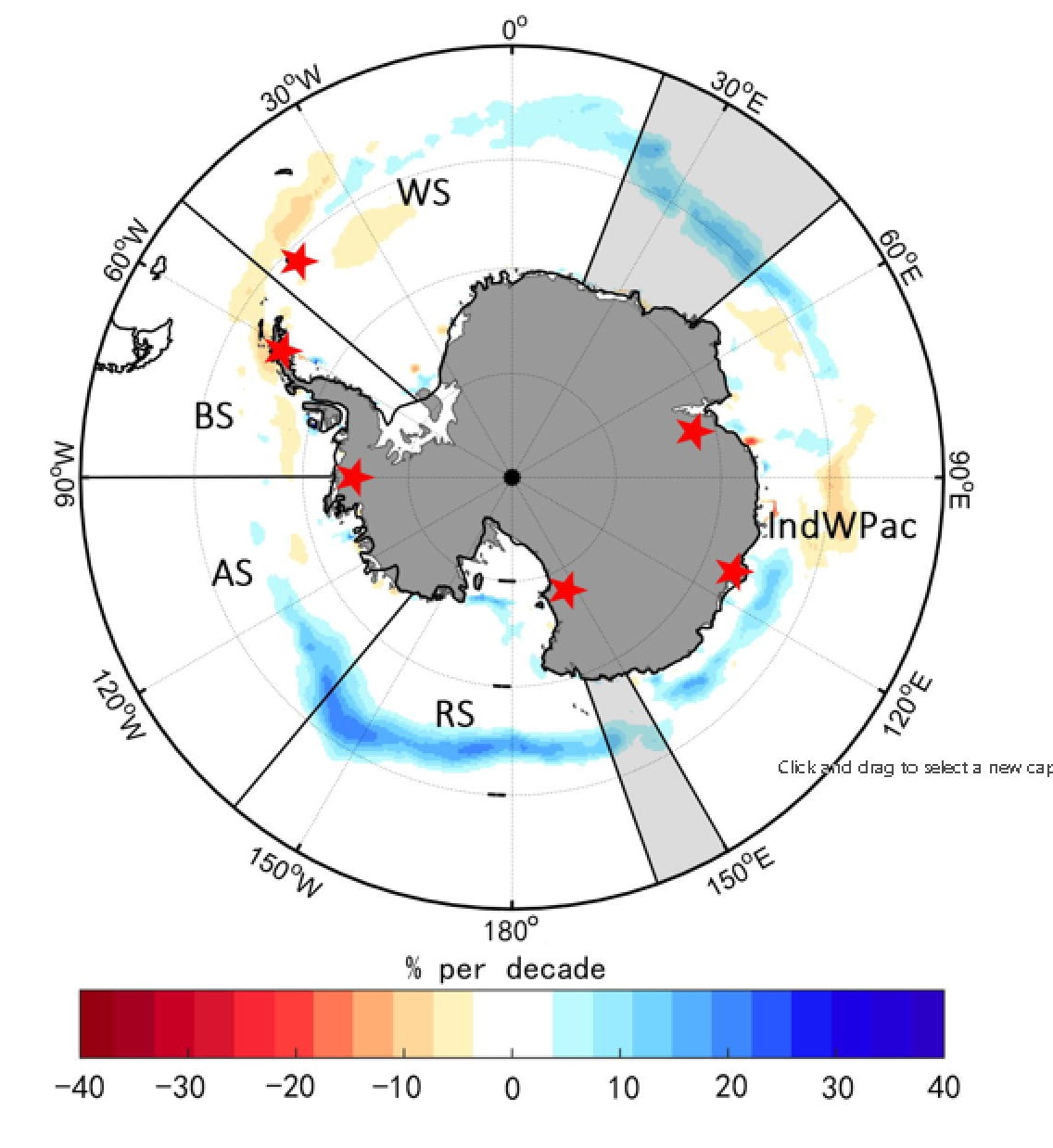
In this study, ice core and fast ice records with annual resolution from six sites are used to reconstruct the annual-resolved northernmost latitude of sea ice edge (NLSIE) for different sectors of the Southern Ocean, including the Weddell Sea (WS), Bellingshausen Sea (BS), Amundsen Sea (AS), Ross Sea (RS), and the Indian and western Pacific Ocean (IndWPac). The linear trends of the NLSIE are analyzed for each sector for the past 100–200 years and found to be −0.08°, −0.17°, +0.07°, +0.02°, and −0.03° per decade (≥95% confidence level) for the WS, BS, AS, RS, and IndWPac, respectively.
For the entire Antarctic, our composite NLSIE shows a decreasing trend (−0.03° per decade, 99% confidence level) during the 20th century, with a rapid decline in the mid-1950s. It was not until the early 1980s that the observed increasing trend occurred.
A comparison with major climate indices shows that the long-term linear trends in all five sectors are largely dominated by the changes in the Southern Annular Mode (SAM). The multi-decadal variability in WS, BS, and AS is dominated by the Interdecadal Pacific Oscillation, whereas that in the IndWPac and RS is dominated by the SAM.
Electrically switchable bright-field and interference-synthesized edge-enhanced imaging with a polarization-multiplexed metalens
Xiaotong Li, Junhwa Seong, Yeseul Kim, Kwang-Suk Oh, Shiqi Hu, Le Dai, Harit Keawmuang, Beomha Yang, Minseok Choi, Youngsun Jeon, Cherry Park, Weiyan Li, Tianxu Jia, Han Zhu, Xiaodong Cai, Qi Zheng, Jinhui Shi, Young-Ki Kim, Yuchuan Shao, Trevon Badloe, Junsuk Rho
Opto-Electronic Science
2026-09-20
3D-printed copper water cooling system assisted fabrication of 10.6-μm high-power CO₂ laser resistance reflectors
Hongfei Jiao, Binbin Jiang, Xinshang Niu, Yifan Wang, Dongdong Li, Jun Yu, Xiaochuan Ji, Jingjing Xia, Jinlong Zhang, Xinbin Cheng, Zhanshan Wang
Opto-Electronic Advances
2026-09-15
Ultrafast all-optical modulation of wide-bandwidth pulses enabled by silicon-metasurfaces
Kaloyan Georgiev, Khosro Zangeneh Kamali, Anton A. Trifonov, Giulia Crotti, Lyuben Petrov, Stefan Georgiev, Hristo Iliev, Lei Xu, Unai Arregui Leon, Mohsen Rahmani, Giuseppe Della Valle, Ivan Buchvarov, Dragomir Neshev
Opto-Electronic Advances
2026-09-15
Physics-informed neural fields enable blind aberration correction for partially coherent quantitative phase imaging
Shun Zhou, Xingyu Huang, Linpeng Lu, Habib Ullah, Kaiyu Du, Maciej Trusiak, Malgorzata Kujawinska, Yuzhen Zhang, Yao Fan, Qian Chen, Qinrong Zhang, Chao Zuo
Opto-Electronic Science
2026-08-26