(Peer-Reviewed) Genetic algorithm assisted meta-atom design for high-performance metasurface optics
Zhenjie Yu 俞臻杰 ¹, Moxin Li 李墨馨 ¹, Zhenyu Xing 邢振宇 ¹, Hao Gao 高豪 ¹, Zeyang Liu 刘泽阳 ¹, Shiliang Pu 浦世亮 ², Hui Mao 毛慧 ², Hong Cai 蔡宏 ², Qiang Ma 马强 ², Wenqi Ren 任文奇 ², Jiang Zhu 朱江 ², Cheng Zhang 张诚 ¹
¹ School of Optical and Electronic Information & Wuhan National Laboratory for Optoelectronics, Huazhong University of Science and Technology, Wuhan, 430074, China
中国 武汉 华中科技大学光学与电子信息学院 武汉光电国家实验室
² Hikvision Research Institute, Hangzhou, 310051, China
中国 杭州 海康威视研究院
Opto-Electronic Science, 2024-09-20
Abstract
Metasurfaces, composed of planar arrays of intricately designed meta-atom structures, possess remarkable capabilities in controlling electromagnetic waves in various ways. A critical aspect of metasurface design involves selecting suitable meta-atoms to achieve target functionalities such as phase retardation, amplitude modulation, and polarization conversion.
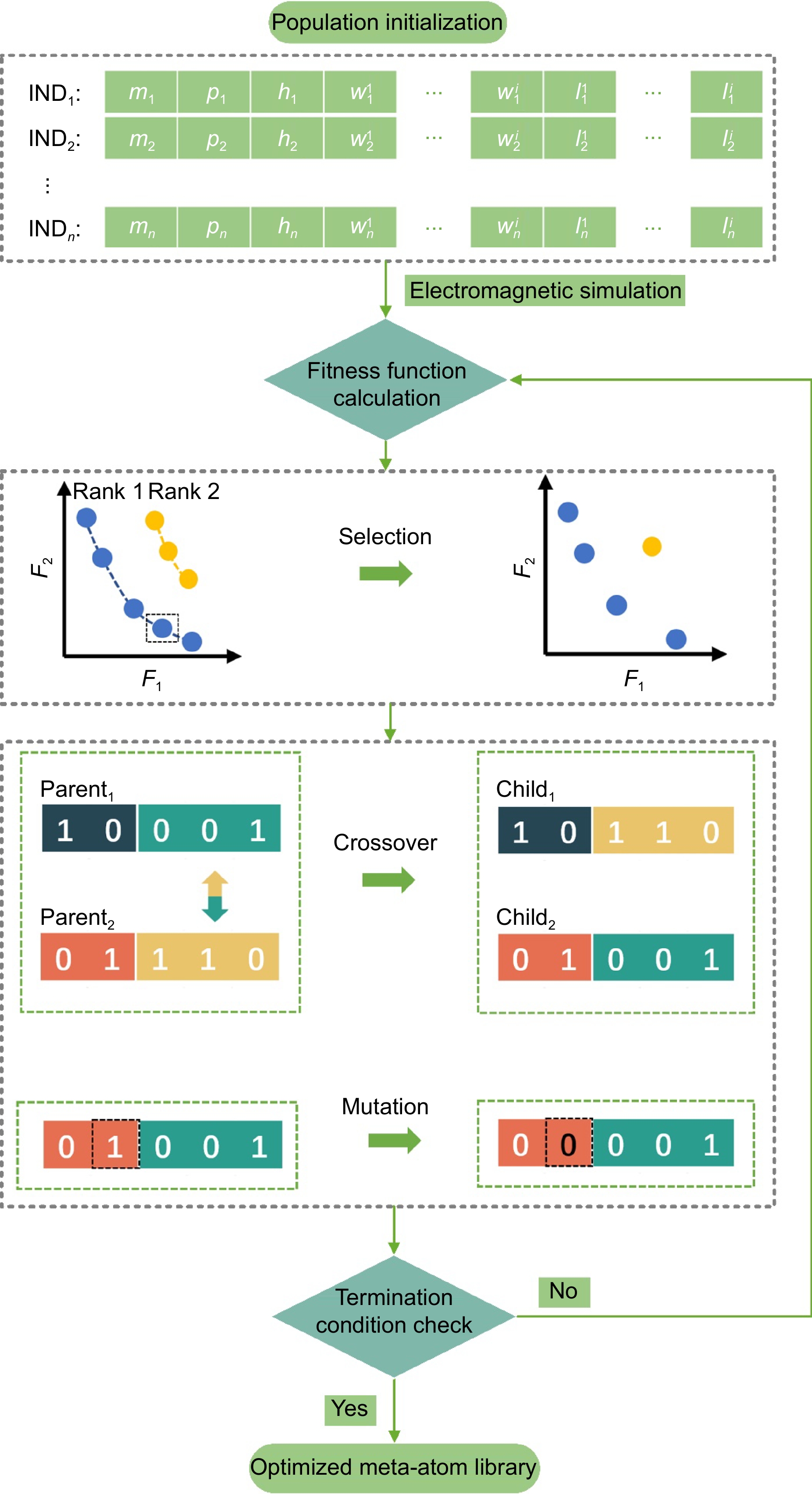
Conventional design processes often involve extensive parameter sweeping, a laborious and computationally intensive task heavily reliant on designer expertise and judgement. Here, we present an efficient genetic algorithm assisted meta-atom optimization method for high-performance metasurface optics, which is compatible to both single- and multi-objective device design tasks.
We first employ the method for a single-objective design task and implement a high-efficiency Pancharatnam-Berry phase based metalens with an average focusing efficiency exceeding 80% in the visible spectrum. We then employ the method for a dual-objective metasurface design task and construct an efficient spin-multiplexed structural beam generator. The device is capable of generating zeroth-order and first-order Bessel beams respectively under right-handed and left-handed circular polarized illumination, with associated generation efficiencies surpassing 88%.
Finally, we implement a wavelength and spin co-multiplexed four-channel metahologram capable of projecting two spin-multiplexed holographic images under each operational wavelength, with efficiencies over 50%. Our work offers a streamlined and easy-to-implement approach to meta-atom design and optimization, empowering designers to create diverse high-performance and multifunctional metasurface optics.
Electrically switchable bright-field and interference-synthesized edge-enhanced imaging with a polarization-multiplexed metalens
Xiaotong Li, Junhwa Seong, Yeseul Kim, Kwang-Suk Oh, Shiqi Hu, Le Dai, Harit Keawmuang, Beomha Yang, Minseok Choi, Youngsun Jeon, Cherry Park, Weiyan Li, Tianxu Jia, Han Zhu, Xiaodong Cai, Qi Zheng, Jinhui Shi, Young-Ki Kim, Yuchuan Shao, Trevon Badloe, Junsuk Rho
Opto-Electronic Science
2026-09-20
3D-printed copper water cooling system assisted fabrication of 10.6-μm high-power CO₂ laser resistance reflectors
Hongfei Jiao, Binbin Jiang, Xinshang Niu, Yifan Wang, Dongdong Li, Jun Yu, Xiaochuan Ji, Jingjing Xia, Jinlong Zhang, Xinbin Cheng, Zhanshan Wang
Opto-Electronic Advances
2026-09-15
Ultrafast all-optical modulation of wide-bandwidth pulses enabled by silicon-metasurfaces
Kaloyan Georgiev, Khosro Zangeneh Kamali, Anton A. Trifonov, Giulia Crotti, Lyuben Petrov, Stefan Georgiev, Hristo Iliev, Lei Xu, Unai Arregui Leon, Mohsen Rahmani, Giuseppe Della Valle, Ivan Buchvarov, Dragomir Neshev
Opto-Electronic Advances
2026-09-15
Physics-informed neural fields enable blind aberration correction for partially coherent quantitative phase imaging
Shun Zhou, Xingyu Huang, Linpeng Lu, Habib Ullah, Kaiyu Du, Maciej Trusiak, Malgorzata Kujawinska, Yuzhen Zhang, Yao Fan, Qian Chen, Qinrong Zhang, Chao Zuo
Opto-Electronic Science
2026-08-26