(Peer-Reviewed) Focus control of wide-angle metalens based on digitally encoded metasurface
Yi Chen 陈义 ¹, Simeng Zhang 章思梦 ¹ ², Ying Tian 田颖 ¹, Chenxia Li 李晨霞 ¹, Wenlong Huang 黄文龙 ¹, Yixin Liu 刘熠昕 ¹ ², Yongxing Jin 金永兴 ¹, Bo Fang 方波 ³, Zhi Hong 洪治 ² ⁴, Xufeng Jing 井绪峰 ² ⁴
¹ Institute of Optoelectronic Technology, China Jiliang University, Hangzhou 310018, China
中国 杭州 中国计量大学 光电材料与器件研究院
² Centre for THz Research, China Jiliang University, Hangzhou 310018, China
中国 杭州 中国计量大学 太赫兹技术与应用研究所
³ College of Metrology & Measurement Engineering, China Jiliang University, Hangzhou 310018, China
中国 杭州 中国计量大学 计量测试与仪器学院
⁴ College of Information Engineering, China Jiliang University, Hangzhou 310018, China
中国 杭州 中国计量大学信息工程学院
Opto-Electronic Advances, 2024-07-23
Abstract
Based on the principle of super-symmetric lens with quadratic phase gradient transformation, combined with the principle of digital coding of metasurface, we propose a wide-angle coded metalens for focusing control in two-dimensional space. This metalens achieves focus shift in the x-direction by changing the oblique incidence angle of the incident wave, and focus control in the y-direction by combining with the convolution principle of the digitally coded metasurface to achieve flexible control of light focusing in the two-dimensional plane.
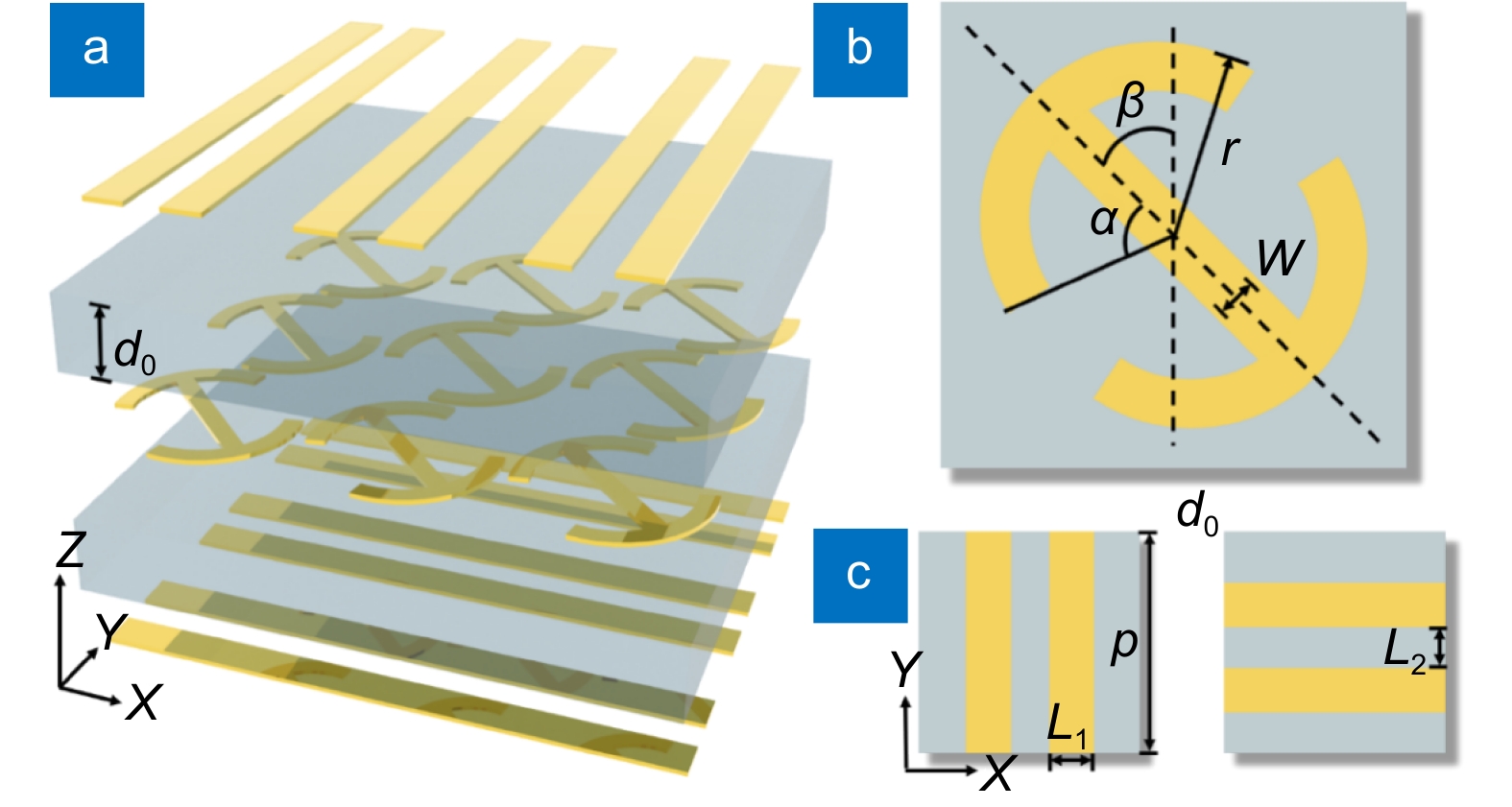
The metasurface unit is mainly composed of three-layer of metal structure and two layers of medium, and the transmission phase is obtained by changing the middle layer of metal structure, which in turn obtains the required phase distribution of the metalens. The design of the metalens realizes the function of the lens with a large viewing angle at the x-polarized incidence, and realizes two-dimensional focus control.
Experimentally, we prepared the designed coding metalens and tested the focus control function of the wide-angle coding metalens. The experimental results are in good agreement with the design results.
Hardware-aware lightweight photonic spiking neural network for pattern classification
Shuiying Xiang, Yahui Zhang, Shangxuan Shi, Haowen Zhao, Dianzhuang Zheng, Xingxing Guo, Yanan Han, Ye Tian, Liyue Zhang, Yuechun Shi, Yue Hao
Opto-Electronic Advances
2026-08-25
PhyspeNet: An empirical physics-aware network for adaptive speckle reconstructive spectrometry
Junrui Liang, Min Jiang, Jun Li, Zhongming Huang, Junhong He, Yanting Guo, Yanzhao Ke, Jun Ye, Jiangming Xu, Jinyong Leng, Pu Zhou
Opto-Electronic Advances
2026-08-25
A 36 × 240 Gbps hybrid mode/wavelength division multiplexing transmitter using lithium niobate on insulator
Mingyu Zhu, Weihan Wang, Ruitao Ma, Aoyun Gao, Chun Gao, Zexu Wang, Fei Huang, Zhenyuan Bao, Dajian Liu, Jiaxuan Gan, Zejie Yu, Huan Li, Weike Zhao, Daoxin Dai
Opto-Electronic Advances
2026-08-25
Light-perception-based interactive control of an underwater digital twin hand
Jinlong Lu, Chao Zhang, Hengchang Nong, Dongying Wang, Hongyu Zhou, Junjie Weng, Yuehua Deng, Yang Yu, Qiang Bian, Jianfa Zhang, Chaofan Zhang, Zhenrong Zhang, Junbo Yang
Opto-Electronic Advances
2026-07-10
Unlocking home-based nocturnal health management: A fiber-optic approach for early detection of cardiorespiratory rhythm disorders
Hanyu Jin, Hao Li, Zhuolin Chen, Liangye Li, Zurui Wang, Kai Zhou, Weijian Hang, Zhipeng Chen, Junfeng Chen, Kai Shen, Jianfeng Wen, Chen Chen, Cunzheng Fan, Zhijun Yan, Feng Wang, Qizhen Sun
Opto-Electronic Advances
2026-07-10
A flexible wireless system for prospective photodynamic therapy applications
Rolan Mansour, Bhavani Yalagala, Vikas Vikas, Nikolas Bruce, Fawziye Tarhini, Georgios N. Arvanitakis, Mohammed Mughal, Jamie Blanche, Ahmad Taha, Jonathan Copper, Muhammad Imran, Karin Williams, Karin Oien, Mahmoud Wagih, Hadi Heidari, Robert Hadfield, David Flynn
Opto-Electronic Advances
2026-07-10
Parallel bright-field and multi-order edge imaging via wide field-of-view trichannel metalens
Xiaotong Li, Yeseul Kim, Youngsun Jeon, Junhwa Seong, Jaekyung Kim, Peng Tang, Shiqi Hu, Harit Keawmuang, Beomha Yang, Dongmin Jeon, Le Dai, Weiyan Li, Xiaodong Cai, Jinhui Shi, Yong-Sang Ryu, Trevon Badloe, Junsuk Rho
Opto-Electronic Advances
2026-07-10