(Peer-Reviewed) Direct detection with an optimal transfer function: toward the electrical spectral efficiency of coherent homodyne detection
Xingfeng Li 李星峰 ¹, Jingchi Li 李靖驰 ¹, Xiong Ni 倪雄 ¹, Hudi Liu 刘虎迪 ¹, Qunbi Zhuge 诸葛群碧 ¹, Haoshuo Chen 陈昊硕 ², William Shieh 谢伟 ³, Yikai Su 苏翼凯 ¹
¹ State Key Lab of Advanced Optical Communication Systems and Networks, Department of Electronic Engineering, Shanghai Jiao Tong University, Shanghai 200240, China
中国 上海 上海交通大学电子工程系 区域光纤通信网与新型光通信系统国家重点实验室
² Nokia Bell Labs, 600 Mountain Ave, Murray Hill, NJ 07974, USA
³ School of Engineering, Westlake University, Hangzhou 310030, China
中国 杭州 西湖大学工学院
Opto-Electronic Science, 2024-12-24
Abstract
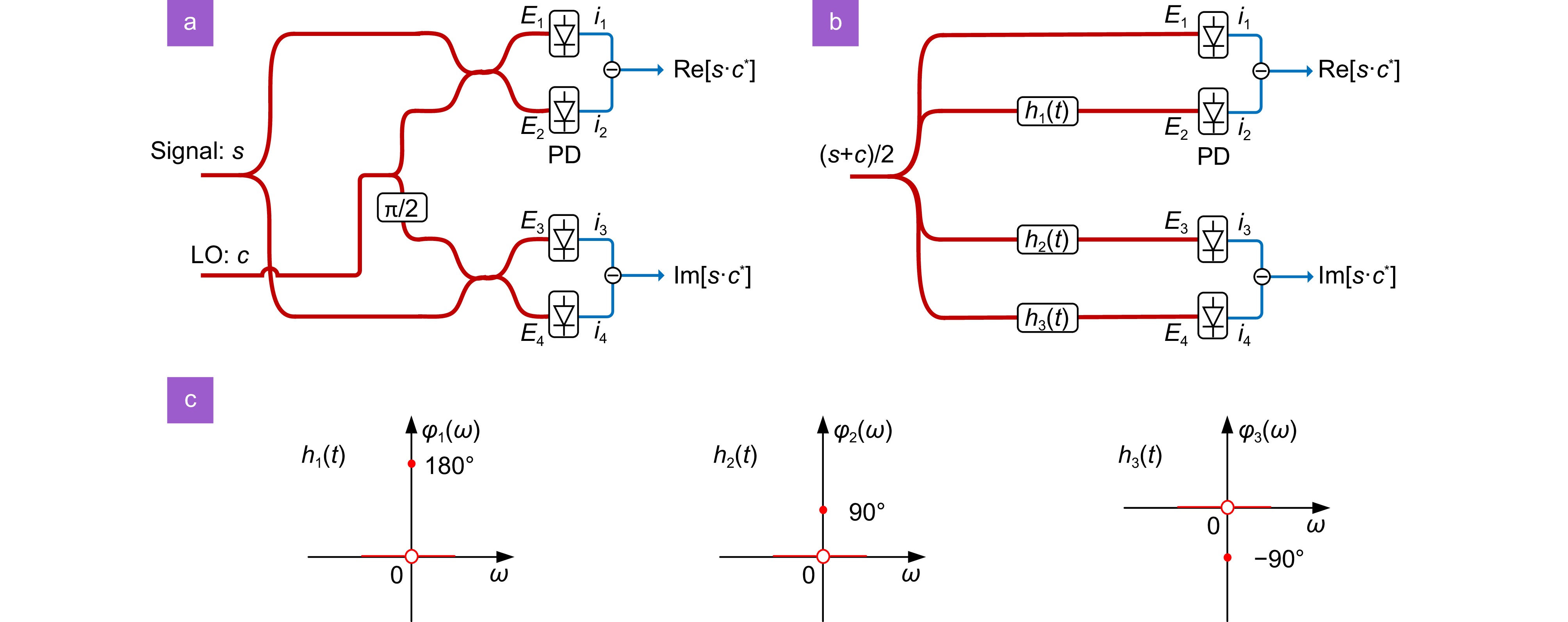
Complex-valued double-sideband direct detection (DD) can reconstruct the optical field and achieve a high electrical spectral efficiency (ESE) comparable to that of a coherent homodyne receiver, and DD does not require a costly local oscillator laser. However, a fundamental question remains if there is an optimal DD receiver structure with the simplest design to approach the performance of the coherent homodyne detection.
This study derives the optimal DD receiver structure with an optimal transfer function to recover a quadrature amplitude modulation (QAM) signal with a near-zero guard band at the central frequency of the signal. We derive the theoretical ESE limit for various detection schemes by invoking Shannon’s formula. Our proposed scheme is closest to coherent homodyne detection in terms of the theoretical ESE limit.
By leveraging a WaveShaper to construct the optimal transfer function, we conduct a proof-of-concept experiment to transmit a net 228.85-Gb/s 64-QAM signal over an 80-km single-mode fiber with a net ESE of 8.76 b/s/Hz. To the best of our knowledge, this study reports the highest net ESE per polarization per wavelength for DD transmission beyond 40-km single-mode fiber. For a comprehensive metric, denoted as 2ᴱˢᴱ×Reach, we achieve the highest 2ᴱˢᴱ×Reach per polarization per wavelength for DD transmission.
Triplet exciton harvesting via TADF in hafnium chlorides array scintillator screen enables ultrahigh-resolution X-ray imaging
Jun'an Lai, Yi Ye, Xu Liu, Sijun Cao, Shiji Zhou, Wenxia Zhang, Kang An, Peng He, Tingming Jiang, Xiaosheng Tang, Rui Zhou, Dong Zhang
Opto-Electronic Advances
2026-06-08
Vacancy oscillating mode in amorphous binary oxide film by terahertz time domain spectroscopy
Huan Liu, Haiyun Huang, Heng Yu, Zhi Gong, Fei Yu, Zheng Zhang, Zhiyong Tan, Juncheng Cao, Haiyun Liu, Kan-Hao Xue, Xiangshui Miao, Yan Liu, Yue Hao, Genquan Han, Qihua Xiong
Opto-Electronic Advances
2026-06-08
Emerging optical techniques for sorting and detection of chiral particles
Yuzhi Shi, Chengfeng Li, Xiaolei Lin, Wenwen Xue, Chengxing Lai, Tao He, Qinghua Song, Zhanshan Wang, Yulan Wang, Din Ping Tsai, Xinbin Cheng, Haidong Zou
Opto-Electronic Advances
2026-06-08
Phonon-assisted absorption photoconductive switch
Zhao Wang, Lixin Zhang, Lu Cheng, Danwen Zhang, Yu Lu, Naiji Zhang, Xin Zhang, Duanyang Chen, Zhan Sui, Hongji Qi, Wei Zheng
Opto-Electronic Science
2026-05-25
Photonic spiking reinforcement learning for intelligent routing
Shuiying Xiang, Yonghang Chen, Ling Zheng, Zhicong Tu, Xintao Zeng, Mengting Yu, Shuai Wang, Yahui Zhang, Xingxing Guo, Weitao Pan, Yue Hao
Opto-Electronic Science
2026-05-25